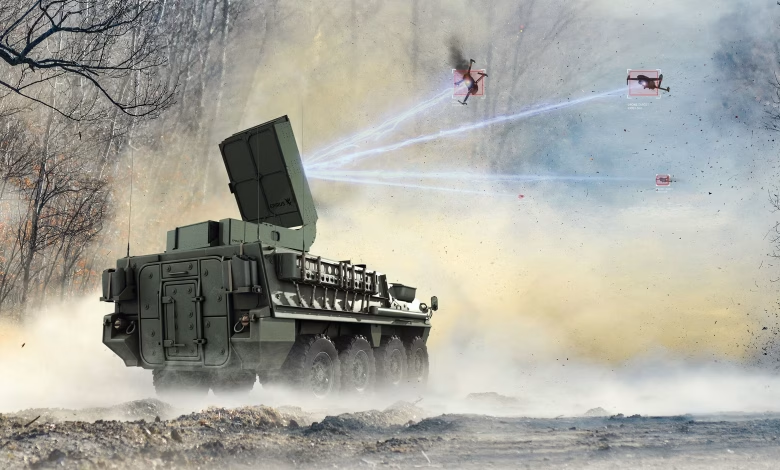
Anti-Drone Weapons: Technologies Defending the Skies in the 21st Century
Unmanned aerial vehicles (UAVs) have transformed modern warfare and civilian security alike. Once limited to military applications, drones are now accessible to virtually anyone — making them a growing threat to airports, power grids, government buildings, and public events. In response, a rapidly expanding industry has emerged around anti drone weapons — specialized counter-UAV systems designed to detect, track, and neutralize rogue drones before they cause harm.
Kinetic Systems
The most traditional approach to countering drones involves physically destroying them. Adapted anti-aircraft guns, shotguns loaded with specialized rounds, and surface-to-air missiles have all been pressed into service. Israel’s Iron Dome system, originally designed to intercept rockets, has been upgraded to handle drone swarms. Some militaries deploy multi-barrel rotary cannons capable of firing thousands of rounds per minute at low-flying targets.
However, kinetic interception comes with a glaring economic problem: destroying a $500 commercial drone with a $300,000 missile is financially unsustainable. This has pushed developers toward smarter, cheaper alternatives — though kinetic systems remain essential when all else fails and an immediate physical threat must be neutralized.
Electronic Warfare and Jamming
Radio frequency (RF) jamming is currently one of the most widely used counter-drone methods. Jammers overwhelm the communication link between a drone and its operator, forcing the UAV to either land, hover in place, or return to its launch point. GPS spoofing takes this further by feeding false location data to the drone’s navigation system, redirecting it away from a protected area.
Portable drone guns — handheld devices resembling rifles — allow a single operator to disrupt a drone’s signal at ranges of up to 2 kilometers. Larger, vehicle-mounted systems can create protective RF exclusion zones around entire facilities. The British DroneGun Tactical and the American D-Fend Solutions EnforceAir are among the most recognized systems in this category.
Laser and Directed Energy Weapons
High-energy laser systems represent the cutting edge of anti-drone technology. The U.S. Air Force’s HELIOS and the Army’s SHORAD programs demonstrate how directed energy can silently and precisely destroy UAVs at the speed of light — with an operational cost of just a few dollars per shot. Raytheon, Lockheed Martin, and Boeing are all actively developing battlefield laser platforms.
These systems excel against drone swarms, where conventional ammunition and missiles would be quickly exhausted. A laser turret can engage multiple targets in rapid succession without reloading. The main limitations remain atmospheric interference (rain, fog, and dust reduce effectiveness) and the significant power requirements needed to sustain high-energy output in the field.
Detection and AI Integration
Neutralizing a drone is only half the battle — finding it first is equally critical. Modern counter-drone systems integrate radar, acoustic sensors, optical cameras, and RF scanners into unified detection networks. Artificial intelligence processes the incoming data in real time, classifying threats and tracking multiple UAVs simultaneously across wide areas.
AI-driven command systems can automatically assign the appropriate countermeasure to each detected drone — jamming a commercial quadcopter while directing a laser at a more sophisticated military UAV — all without human intervention. This level of automation is essential when dealing with coordinated swarm attacks designed to overwhelm human operators.
The Road Ahead
The drone threat is evolving faster than ever. Autonomous swarms guided by onboard AI, miniaturized explosive payloads, and signal-independent navigation are pushing counter-drone technology to its limits. The future of aerial defense will likely rely on layered systems — combining detection networks, electronic warfare, directed energy, and kinetic interceptors — working in concert under intelligent automated control. In an era when a $200 drone can threaten a billion-dollar facility, the race between attack and defense has never been more urgent.